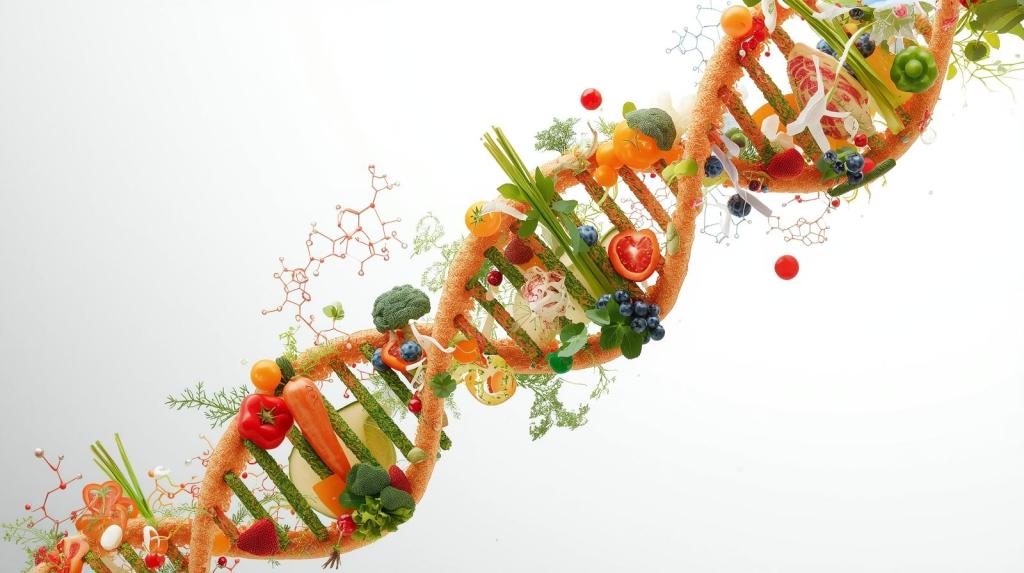
For decades, nutritional science has been built on the myth of the “Average Human.” We see it in every Recommended Dietary Allowance (RDA) and every trending diet plan that promises universal results. But as a biotechnologist, I approach life from a different perspective—one where “averages” disappear and individual molecular signatures take over.If you have ever wondered why your best friend thrives on a high-fat ketogenic protocol while you feel cognitively foggy and lethargic, the answer isn’t a lack of willpower. The answer is likely written in your Single Nucleotide Polymorphisms (SNPs).
What is Nutrigenomics?
At its core, Nutrigenomics is the study of how nutrients act as signaling molecules to influence gene expression. We are transitioning from the “Food as Fuel” era to the “Food as Information” era. We are no longer just asking what a food contains; we now examine the signals that food sends to our DNA.
For example, consider the gene CYP1A2, which encodes the cytochrome P450 1A2 enzyme. This enzyme is responsible for metabolizing 95% of your caffeine intake. A subtle variation in this gene determines whether you are a “fast” or”slow” metabolizer.
- For a fast metabolizer, caffeine may be cardio-protective.
- For a slow metabolizer, that same cup of coffee can lead to prolonged cortisol spikes and an increased risk of hypertension.
Why Your DNA is Not Your Destiny
The beauty of biotechnology in 2025 is that we now have the tools to move from “reactive” healthcare to “proactive” molecular management. By understanding your genetic predispositions—from how you process Vitamin D (VDR gene) to your inflammatory response to saturated fats—you can bypass the trial-and-error phase of wellness.
In this post, we will strip away the marketing hype of at-home DNA kits and look at the actual clinical data. What can your genome really tell you about your plate?
A Note from the Author: The science of nutrigenomics is evolving faster than the regulations surrounding it. As a PhD in Biotechnology, I believe the future of health isn’t in a ‘standardized’ pill or diet, but in the data-driven optimization of our own unique biology.
Are you a biotech startup or a health-conscious reader looking for a deeper dive into the literature? I specialize in translating complex genomic data into actionable insights. Let’s discuss the science in the comments below, or reach out for professional scientific writing and consulting inquiries.
Reference
Lagoumintzis G, Afratis NA, Patrinos GP. (2024). Nutrigenomics and personalized nutrition: advancing basic, clinical, and translational research. Front Nutr. doi: 10.3389/fnut.2024.1435475. View Study
Researcher’s Note: While many commercial DNA tests focus purely on ancestry, the work by Lagoumintzis et al. (2024) highlights that the true value lies in clinical utility—using your genetic markers to prevent chronic disease before it starts.
 Wellness by Science
Leave a comment