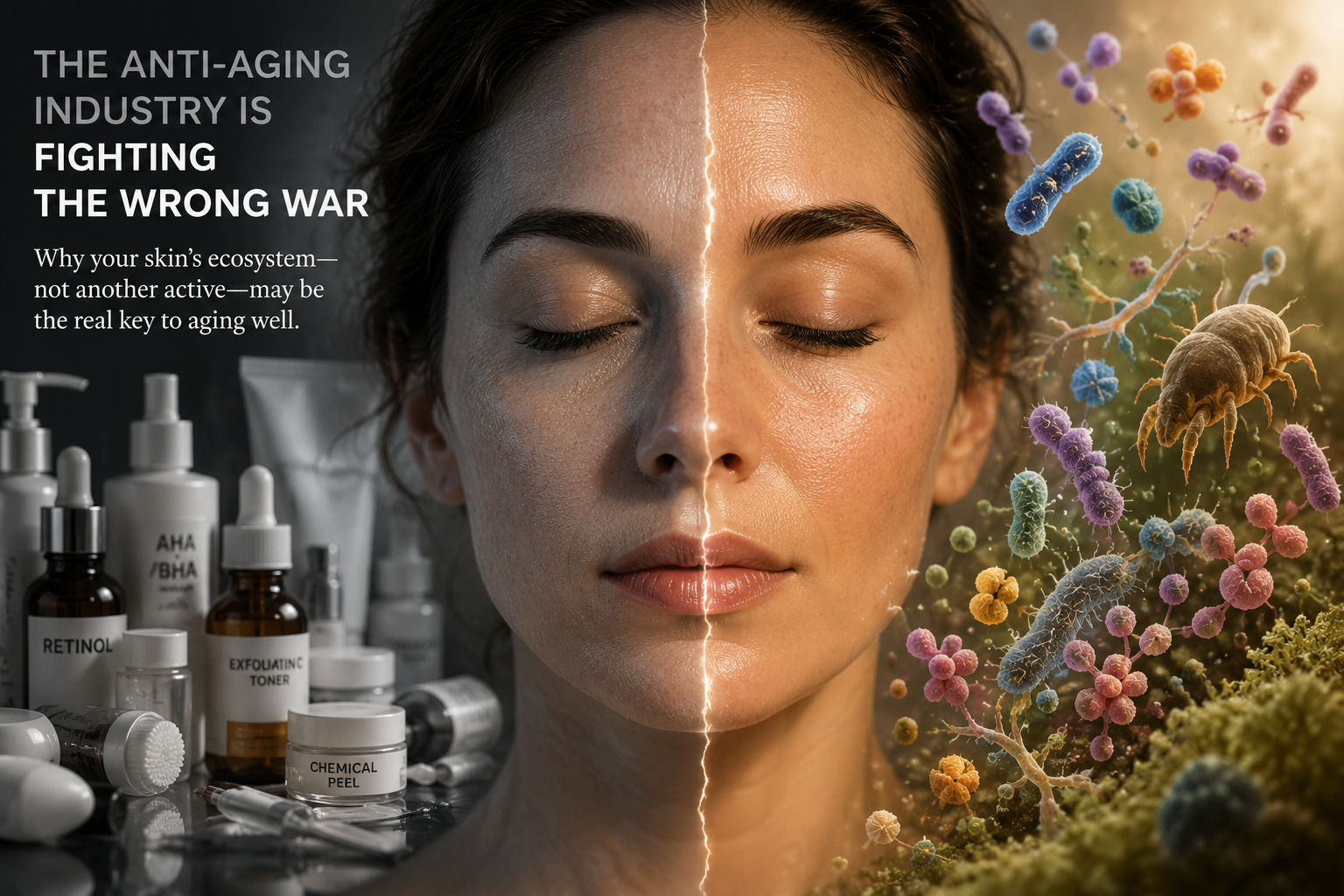
The Skin Is an Ecosystem
A recent Perspective in Science made a quiet but pointed argument: skin doesn’t just age — it ages as an ecosystem. The authors, reviewing evidence from human cohorts, mouse models, and reconstructed skin tissue, describe a resident community of bacteria, fungi, and mites that actively helps maintain barrier strength, calibrate immune tolerance, and resolve inflammation.
When that community destabilizes with age — losing key acid-producing species, becoming less diverse, ceding ground to opportunistic strains — skin doesn’t just look older. It may function less resiliently, in ways that ripple into inflammation, infection risk, and slower healing.
Why the Traditional Anti-Aging Model May Be Incomplete
It’s a genuinely interesting scientific reframing. It’s also, if you sit with it, an uncomfortable one for an industry built almost entirely on the opposite premise.
Walk through any skincare aisle or app, and you’ll see a clear message: skin needs fixing. Wrinkles are problems to smooth out. Bacteria are dangers to eliminate. Texture is something to scrub away. The whole “anti-aging” market, worth billions, is based on a battle theme: actives fighting aging, with actives gaining strength with every slight increase in concentration.
The Science piece doesn’t use the word “paradox,” but it’s hard not to see one once you hold the ecosystem framing next to the ingredient list of a typical modern routine. If the resident microbial community is a working part of skin’s defense system — not just passengers, but active contributors to barrier lipids, immune training, and inflammation control — then a strategy of routine, cumulative disruption is, at minimum, worth scrutinizing. At worst, it may be quietly undermining the very resilience the industry claims to be selling.
What Actually Disrupts the Ecosystem
This isn’t speculative. Several of the mechanisms the industry relies on have documented, measurable effects on the skin’s microbial community — though, notably, the size and durability of those effects vary a lot by ingredient, and the picture is far from simple.
Cleansing and pH
Skin’s surface sits naturally around pH 4.5–5.5 — mildly acidic, a condition that suppresses pathogenic bacteria and supports acid-loving commensals like Cutibacterium acnes. Many conventional cleansers and soaps are alkaline, and a body of dermatology research going back decades shows that high-pH washing swells the stratum corneum, strips barrier lipids, and shifts the microbial balance toward less favorable populations — including a depletion of protective C. acnes and an increased proliferation of S. aureus under elevated pH conditions, along with a documented tendency for yeast species to shift toward more pathogenic forms. Reformulating toward pH-balanced, milder surfactants isn’t a fringe idea; it’s already standard advice in dermatology literature. It just isn’t standard practice on drugstore shelves.

Actives
Retinoids are trusted anti-aging agents, with recent microbiome studies revealing complex results. A 2024–2026 study showed that four weeks of topical retinol reduced facial skin microbiome diversity and specific resident species, while enhancing skin hydration, barrier function, and reducing wrinkle depth. This raises questions about whether the change in microbial composition is a cost, side effect, or part of the benefit mechanism. Ultimately, the understanding of this relationship remains unclear; a healthy microbiome isn’t necessarily the most diverse, and changes in microbial composition don’t always indicate harm.
Cumulative Product Exposure
One of the least-researched aspects of this paradox is the modern skincare routine, which often includes ten to fifteen products—cleanser, toner, essence, serums, acids, retinoid, moisturizer, and sunscreen used morning and night. These extensive routines are marketed as thorough, yet there is little research on how these products work together over time, especially on aging skin. Most studies on the microbiome focus on younger skin, while aging skin—often drier and with fewer protective lipids—remains underexplored and more susceptible to the effects of multiple products. This presents a significant issue, as the impact on the skin’s ecosystem is not only a concern but also largely untested, masquerading as a thorough approach to skincare.
The Makeup Question
The layering burden doesn’t stop at serums. Foundation, concealer, powder, blush, and contour sit on top of all of it — often for eight or ten hours a day — and they raise a related but distinct set of concerns, because decorative makeup isn’t trying to penetrate or actively change skin the way an active ingredient is. It’s mostly just sitting there.
Three separate mechanisms are worth pulling apart:
- Antimicrobial Load: Cosmetic products need their own preservative systems to keep from growing bacteria and mold in the packaging, and that antimicrobial load doesn’t stay confined to the tube — research on personal-care products has measured meaningful, if temporary, reductions in surface microbial counts during and after application.
- Pore Congestion and Oxygen Drops: Heavy, long-wear foundations and concealers rely on pigments and film-formers that mix with your natural sebum and settle into your pores. When left on the skin for 8 to 10 hours, this cosmetic layer congests the pore opening, causing the oxygen levels inside to drop. This is a critical trigger: Cutibacterium acnes is an anaerobic bacterium, meaning it thrives when oxygen is cut off. This sudden oxygen depletion creates the perfect micro-environment for it to rapidly overgrow, shifting the microbial balance and triggering inflammation.

- Contamination Vectors: Makeup applicators are a documented contamination vector in their own right. Multiple independent studies have found makeup brushes and damp sponges heavily colonized with bacteria — including Staphylococcus and Pseudomonas species — when not cleaned regularly, introducing foreign microbial load with every use.
The Probiotic Skincare Paradox
Here’s where the paradox becomes almost self-aware. The same industry accelerating this cumulative product load is simultaneously racing to capitalize on the ecosystem science that complicates it. According to Innova Market Insights, global personal-care launches carrying microbiome-related claims grew by 52% between April 2019 and March 2024, with skincare accounting for 41% of these microbiome-claim launches. The numbers suggest that microbiome science is moving rapidly from a scientific niche into mainstream beauty marketing.
But there’s a formulation problem sitting underneath the marketing. Conventional cosmetic preservation systems are designed to prevent microbial growth in the product. Keeping beneficial live microorganisms viable, stable, and safe throughout a product’s shelf life is therefore a substantial formulation challenge.
As a result, many products marketed using “probiotic” language do not contain live bacterial cultures. Instead, they may contain bacterial lysates, ferments, or cell-derived ingredients—materials derived from microorganisms but not necessarily containing viable organisms. Others use postbiotic preparations, which can include inactivated microorganisms and/or their components and metabolites.
To be scientifically fair, these ingredients are far from worthless. Inactivated microbial cells and their components can interact with pattern-recognition receptors in the skin and may influence inflammatory signaling, while microbial-derived metabolites and fermentation products can potentially support barrier function. Their value does not depend on the presence of living bacteria.
The important point is that a microbial-derived ingredient is not the same thing as a living microbial intervention.

When “Microbiome-Friendly” Becomes a Marketing Term
That distinction matters because “probiotic skincare” can easily evoke the idea of replenishing beneficial bacteria on the skin. But a product containing a bacterial lysate or microbial-derived ingredient is not necessarily designed to introduce and sustain a living microbial population. One supplies microbial components or signals; the other would aim to alter the living ecosystem itself.
That does not make lysates, ferments, or postbiotic preparations ineffective. It simply means that the marketing language and the underlying biology are not always describing the same intervention.
And this is where the ecosystem approach becomes important. If the goal is genuinely to work with the skin microbiome, the question is not simply whether a product contains something derived from bacteria. It is whether the formulation can meaningfully influence the living microbial community and the habitat in which that community exists.
By that standard, “microbiome-friendly” remains a promising but still scientifically evolving category—not a settled technological solution.
What the Science Actually Suggests
Read closely, the Science piece’s own prescription is notably humble. The authors suggest two complementary paths:
- Microbe-centered interventions: Introducing specific beneficial strains.
- Habitat-centered interventions: Repairing barrier lipids, restoring pH, calming inflammation, so that a hospitable environment exists for beneficial microbes to return on their own.
They explicitly note that a transplanted microbial strain won’t survive without the right pH, nutrients, and physical niche. Meaning habitat repair may be the more foundational, and more immediately actionable, lever.
That’s a strikingly different paradigm than either “attack everything” or “buy the strain-of-the-month serum.” It points toward something closer to the shift already underway in oral care — away from broad-spectrum antimicrobial “scorched earth” and toward biocompatible, barrier-supporting formulations.
What We Still Don’t Know
The Science authors are careful, repeatedly, to say that most of the human aging-skin evidence is correlational. Causality between microbial shifts and functional decline “remains to be demonstrated.” Furthermore, the research tools needed to settle these questions — aged-specific skin models, strain-level functional testing, longitudinal sampling — largely don’t exist yet.
The retinol data above is a useful corrective against tidy narratives: a genuinely effective anti-aging ingredient that also measurably disrupts microbial diversity, with no clear verdict yet on whether that trade-off matters.
Conclusion: The Anti-Aging Industry Is Fighting the Wrong War
It would be its own kind of overreach to turn this into a simple morality tale — natural good, synthetic bad, minimalist virtuous, active-laden reckless.
What the Science Perspective supports is a shift in how we think about skin—from seeing it as something to conquer to viewing it as a living system that needs balance. The question remains whether specific product lines genuinely embrace this idea or simply use the terminology. “Microbiome-friendly” is a key example of whether the beauty industry can integrate this ecosystem concept without reducing it to just a catchy phrase.
Disclaimer: This piece reflects analysis and interpretation of the cited Science Perspectives article and independently reviewed research; it is not medical or dermatological advice. Individual skin needs vary, and readers with specific skin conditions should consult a dermatologist rather than restructure a routine based on this article alone.
Leave a Reply