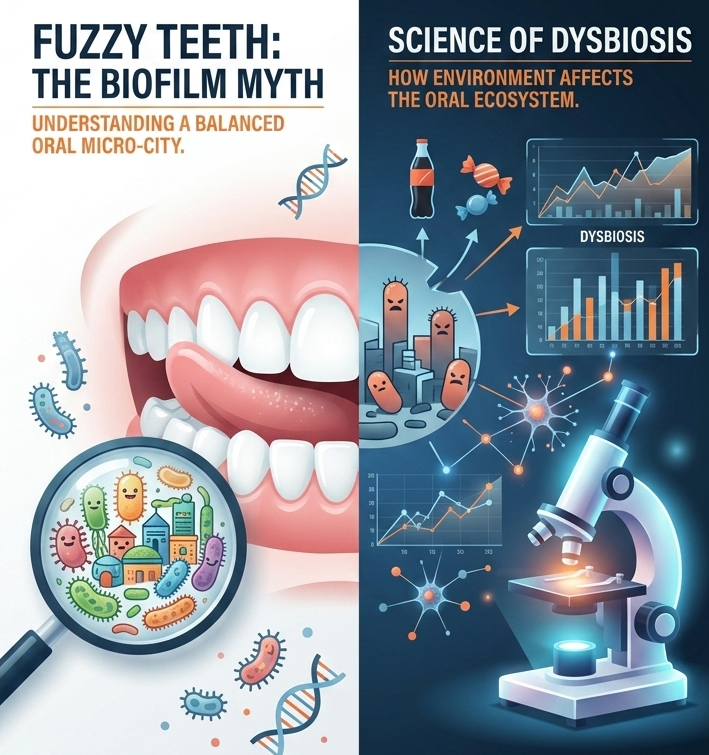
Take a moment to run your tongue across your teeth right now — especially first thing in the morning, before you’ve brushed them. That faint, fuzzy film? It’s not a sign that something has gone wrong. That’s dental plaque, and it’s present whether your mouth is perfectly healthy or starting to develop a cavity.
That surprises most people. Plaque is often portrayed as a villain—something you need to get rid of and a sign of poor dental hygiene. However, recent research on the oral microbiome presents a different perspective: plaque is a natural, living structure that forms on your teeth regardless of how well you care for them. In a healthy mouth, plaque can actually be beneficial.
Plaque Is a Biofilm, Not a Stain
The key concept that researchers continually revisit is that plaque is not merely “leftover food” or passive bacterial residue on your teeth; it is actually a biofilm. This biofilm is a structurally organized, functioning microbial community, resembling a small, self-built city rather than just a smear of grime.
Figure 1: A detailed diagrammatic depiction of biofilm formation on a dental structure, showing the 5-step transition from free-floating bacteria to a mature, highly structured ‘microscopic city’.
That city has impressive architecture. Research on oral biofilms reveals that they form in organized layers, with different species inhabiting specific areas based on the surface, local chemistry, and available oxygen levels. Early colonizing bacteria attach first, altering the surface just enough to allow other species to settle in—much like the first settlers in a city build infrastructure before newcomers arrive. Over time, the community knits itself together through a self-produced matrix that holds everything in place and helps the community share nutrients, signals, and even genetic material.
This isn’t a fringe finding — it’s foundational to modern dental microbiology, dating back to the influential work of microbiologist Philip Marsh, who has spent decades documenting how dental plaque behaves as a structurally and functionally organised biofilm rather than a haphazard buildup.
The Part That Surprises People: It’s Supposed to Be There
Here’s a key point that challenges the common belief “plaque = bad” instinct: research consistently shows that a healthy mouth is not a plaque-free mouth. It’s a mouth where the plaque biofilm exists in a stable, balanced state.
The oral microbiota — including the bacteria that make up plaque — actively benefits its host. Studies point to several jobs this resident community does for you:
Crowding out invaders: A well-established microbial community makes it physically and chemically harder for new, potentially harmful species to gain a foothold — a phenomenon researchers call colonization resistance.
Keeping inflammation in check: Rather than constantly triggering your immune system, a balanced oral microbiome helps tone down unnecessary inflammatory responses.
Supporting normal development: The resident microbiota contributes to the normal physiological development of the mouth and to training your body’s own defenses.
In other words, in health, this community is less like an intruder and more like a long-term tenant that keeps the building running — and generally, these communities live in genuine harmony with you. That relationship even has a name: symbiosis.
So Why Does Plaque Turn Into a Problem?
If plaque is normal, why do dentists still advise you to remove it? The key factor is not just the presence of plaque, but the composition of the biofilm that determines whether it is harmless.
TThis concept is central to the ecological plaque hypothesis, which is one of the most influential theories in the modern study of tooth decay. The idea is straightforward: your resident plaque bacteria are opportunists that respond to their environment. When conditions stay stable, the microscopic city stays balanced. However, if the environment changes—such as through frequent sugar intake—this can alter the local ecosystem, allowing more harmful bacteria to thrive and take over.
This diagram highlights the everyday factors that disrupt a healthy oral microbiome. Use it as a quick self-check for your own daily habits!
Here’s the mechanism in plain terms:
You eat something sugary. Certain resident bacteria — the few “vandals” already living in the city, doing no harm in small numbers — ferment those sugars and produce acid.
Repeated, frequent acid exposure changes the environment. It favors bacteria that tolerate and even thrive in low-pH conditions.
These acid-loving species gradually out-compete the good neighbors, shifting the overall balance and demographics of the biofilm.
The now acid-dominant biofilm demineralizes enamel — and that’s how a normal, healthy microscopic city becomes the cause of a cavity.
Researchers call this shift from a balanced to an unbalanced microbial community dysbiosis .Understanding this concept is important because it reframes the goal of oral care. Instead of trying to sterilize your mouth, you should aim to prevent the composition of the unavoidable biofilm from shifting toward harmful bacteria.
What This Means for How You Actually Brush
This research has a very practical payoff, and it’s a bit different from “kill all the germs”:
Frequency of sugar exposure matters more than total amount. The frequency with which we consume sugar is more significant than the total amount consumed. Acid-tolerant bacteria benefit from repeated drops in pH, meaning that snacking on sugary foods and drinks throughout the day disrupts the balance of the biofilm more than consuming the same amount of sugar in one sitting.
Mechanical disruption is what resets the community. Brushing and flossing don’t need to (and can’t) eliminate plaque permanently — they disrupt its structure and buy time before it re-matures into a dense, organized biofilm again, which is part of why twice-daily brushing is the standard recommendation rather than a one-time deep clean.
Fluoride works partly as an environmental modulator. Beyond strengthening enamel directly, fluoride and similar agents help create conditions that are less favorable to acid-tolerant species, nudging the biofilm’s competitive balance back toward the harmless majority.
A completely “plaque-free” mouth isn’t the realistic or necessary goal. Modern research treats a mature, stable, diverse biofilm as a sign of a well-functioning oral ecosystem — the target is balance, not eradication.
The Takeaway
That fuzzy feeling on your teeth in the morning isn’t evidence you’re failing at oral hygiene — it’s evidence you have a mouth, and mouths grow biofilms. The real question a healthy biofilm answers is not whether plaque is present, but “is this community still in balance?”
Understanding plaque as a living, structured, mostly friendly microbial community that can become destabilized — rather than a substance to eradicate completely — represents an important shift in perspective from oral microbiome research over the past two decades.decades.
Now that you know your mouth is a delicate microscopic city, are you accidentally carpet-bombing it with your toothpaste? Click here to read the 4 ingredients you need to check your label for.”
Next up: We head south from the mouth to the gut, where a very similar biofilm story plays out — except this time, the microscopic city might be protecting you from far more than cavities.
A synthesis of recent research on dietary protein needs, muscle science, and the limits of what we actually know
The Most Confident Nutrition Conversation in the Room
Ask almost anyone at a gym, a nutrition clinic, or a dinner table about protein and you will get confident answers:
Eat 30 grams per meal.
Hit 0.8 grams per kilogram of body weight.
High protein damages your kidneys.
Animal protein is better than plant protein.
More is always better when you’re losing weight.
Protein has cemented its status as one of the most talked-about nutrients in today’s nutrition landscape. Numerous surveys indicate that an increasing number of people are intentionally raising their protein intake, driven by diverse goals, including muscle growth, healthy aging, weight management, and enhancing metabolic health.
However, beneath the surface of these confident claims lies a scientific narrative that is far more intricate than many popular recommendations suggest.
In February 2025, more than twenty international protein researchers gathered at Indiana University’s School of Public Health-Bloomington for a workshop titled Human Dietary Protein Needs and Benefits: A Critical Assessment of Postulated Propositions. Their mission was clear and ambitious: to rigorously evaluate the evidence supporting many entrenched assumptions in protein recommendations.
Their conclusion was striking. While protein’s importance is unquestioned, many commonly repeated claims are supported by evidence that is either incomplete, limited, or methodologically restricted.
The gap between public certainty and scientific evidence on dietary protein is not a minor discrepancy. It is, in many areas, a chasm. This gap affects everyone from the casual gym-goer to the millions of people currently losing weight on GLP-1 medications like Ozempic, who may unknowingly be facing severe muscle loss.
This article examines what recent research suggests about dietary protein—and equally important, what it still cannot tell us with confidence.
Part I: The Measurement Problem — Why Protein Data Is Harder Than It Looks
Before examining what we know about protein, it is worth understanding why we don’t know more. The Indiana University workshop specifically flagged methodological issues as a foundational problem — and a 2025 review from the University of Nottingham illustrates exactly why.
Much of protein science revolves around a process called muscle protein synthesis (MPS)—the rate at which amino acids are incorporated into new muscle tissue.
The Old Approach: Acute Measurements
For decades, researchers measured MPS over short periods, typically only a few hours after a meal or supplement. These studies produced many of the protein recommendations still circulating today. However, a higher MPS reading in a four-hour window does not necessarily translate to more muscle built over a training cycle.
The New Approach: Measuring Real Life
Newer techniques using deuterium oxide, often called “heavy water,” allow scientists to track muscle protein synthesis continuously over days and weeks. This provides a more realistic picture of how dietary protein strategies actually affect muscle tissue over time.
The practical implication is important: A substantial portion of the protein research underpinning current recommendations was conducted using methods too short-term and too artificial to tell us what we most need to know. Most studies were also conducted in young, healthy, resistance-trained males — leaving enormous gaps in the evidence base for women, older adults, children, and people with metabolic conditions.
As a result, some of the most widely repeated protein recommendations may not be equally applicable to everyone.
Part II: How Much Protein Do You Actually Need?
The Recommended Dietary Allowance (RDA) for protein remains 0.8 grams per kilogram of body weight per day.
However, many researchers now argue that optimal intakes—particularly for active individuals and older adults—are likely higher than this minimum requirement.
The Leucine Threshold
The most significant finding in a 2024 paper in Frontiers in Nutrition was the central role of leucine, an amino acid that acts as the metabolic trigger for muscle growth.
The Leucine Threshold Graphic. Leucine acts as a biological switch for muscle building. As we age, anabolic resistance raises this threshold, requiring larger doses of protein per meal to flip the switch.
A meal must contain enough leucine to activate the anabolic response.However, this effect is deeply entangled with age. Older adults experience “anabolic resistance,” meaning they require a significantly higher dose of leucine to trigger the exact same muscle-building response as a 25-year-old.
Aging Changes the Equation
As people age, muscles become less responsive to protein intake. A protein dose that effectively stimulates muscle growth in a younger adult may produce a smaller response in an older individual. Research suggests that older adults may benefit from larger protein doses per meal and greater attention to overall protein quality.
The Muscle-Full Effect Under Re-Examination
Closely related is the “muscle-full” hypothesis — the idea that muscle protein synthesis simply switches off after about two hours, regardless of how much protein is in your blood. As of December 2024, an active clinical trial at Maastricht University is specifically designed to re-examine this phenomenon in real-world eating patterns. Results are expected to significantly revise current thinking on how we utilize protein per meal.
Part III: The 40-Gram Myth
One of the most persistent beliefs in fitness culture is that the body can only utilize about 20–40 grams of protein per meal for muscle building. Anything beyond that, the story goes, is wasted.
Recent evidence suggests the reality is considerably more complex. Researchers have observed that consuming larger protein doses can continue to support anabolic responses for much longer periods than previously assumed.
The key appears to be digestion rate. Fast-digesting proteins such as whey produce a rapid spike in amino acids, whereas slower-digesting proteins and whole-food meals release amino acids gradually over many hours.
This suggests that the often-cited 20–40 gram ceiling is not a universal biological limit but rather an oversimplification of a much more dynamic process. The body does not suddenly stop using amino acids after a specific threshold is reached. Instead, utilization appears to depend on factors such as age, protein source, meal composition, activity level, and overall daily intake.
Part IV: Protein During Weight Loss — The Stakes Are Higher Than Most People Realize
Weight loss is often discussed in terms of fat reduction. In reality, when the body is in a caloric deficit, it draws on both fat and lean tissue for energy. How much muscle is lost alongside fat depends substantially on how much protein is consumed and when.
Understanding human body composition is crucial during weight loss. Without adequate protein, the body will strip away vital muscle tissue alongside fat stores.
What the Meta-Analysis Shows
A 2024 systematic review synthesized data on protein intake during weight loss. The findings drew a clear line:
Below 1.0 g/kg/day: Associated with a measurably higher risk of muscle mass decline.Several reviews indicate that higher protein intakes during weight loss are associated with better preservation of lean mass, greater satiety, and increased thermogenesis.
Above 1.3 g/kg/day: Associated with increased muscle mass preservation during weight loss.
High-protein diets during caloric restriction also produced greater thermogenic effects (burning slightly more energy during digestion) and provided greater satiety, making diet adherence easier.
For individuals attempting to lose weight while maintaining strength, mobility, and metabolic health, protein appears to play a particularly important role.
The GLP-1 Blind Spot
As mentioned in the introduction, the most urgent protein story right now involves GLP-1 receptor agonist medications (like semaglutide). An August 2025 study found a troubling pattern: because these drugs dramatically suppress appetite, users are frequently falling well short of the recommended 1.2–2.0 g/kg/day needed for muscle preservation.
The demand for these drugs is so unprecedented that it has sparked international supply shortages and legal battles. For instance, in June 2026, a South African High Court granted Novo Nordisk an order to block local pharmacies from manufacturing and selling unregistered, compounded copies of semaglutide.
With the global market flooded by both official prescriptions and unregulated compounded alternatives, the sheer scale of the potential muscle-loss crisis is staggering. Millions of people successfully losing weight may be losing substantial lean muscle mass alongside the fat — an outcome with serious long-term consequences for metabolic health, functional capacity, and aging.
Part V: What About Women?
One limitation of protein science receives surprisingly little attention: historically, many muscle metabolism studies have focused on young, resistance-trained men. Women remain underrepresented in numerous areas of sports nutrition research.
This matters because hormonal fluctuations, pregnancy, breastfeeding, menopause, and differences in body composition may all influence protein metabolism and muscle adaptation. Although existing evidence suggests that many general protein principles likely apply across sexes, important questions remain unanswered. As researchers continue to broaden study populations, future recommendations may become more individualized and better tailored to women’s unique physiological needs.
Part VI: Is High Protein Harmful?
Questions about high-protein diets often center on two concerns:
Kidney health
Bone health
Kidney Function
For individuals with existing kidney disease, higher protein intakes may accelerate the decline of renal function and should be managed under medical supervision.
For healthy individuals, however, the long-term evidence remains less definitive than commonly portrayed.
Current research has not consistently demonstrated significant harm; however, it has not generated sufficient high-quality, long-term studies to fully resolve the debate.
Bone Health
Earlier concerns suggested that higher protein intake could weaken bones because it increases urinary calcium excretion. More recent research paints a more nuanced picture. When dietary calcium intake is adequate, higher protein consumption may be neutral—or potentially beneficial—for bone health. The overall evidence remains mixed, but the simplistic narrative that protein automatically harms bones is increasingly difficult to support.
Part VII: The Indiana University Verdict — A Reminder of Scientific Humility
One of the most interesting outcomes of the Indiana University workshop was not a dramatic new discovery. It was a reminder of how science actually progresses.
For many popular protein propositions, researchers concluded that more evidence is needed—not because the ideas were necessarily wrong, but because the available evidence remains limited in quality, quantity, or applicability.
This is not a failure of science. It is science functioning exactly as intended. The most reliable researchers are often the ones most willing to acknowledge uncertainty.
Practical Takeaways: What Should You Eat Tomorrow?
While many questions remain unresolved, several practical conclusions emerge from the current evidence.
Aim Beyond the Minimum
The RDA of 0.8 g/kg/day appears sufficient to prevent deficiency, but many experts believe higher intakes are likely beneficial for active adults and older individuals. A daily intake of approximately 1.2–1.6 g/kg/day is often suggested as a reasonable target.
Don’t Obsess Over the 40-Gram Rule
The body does not appear to operate with a rigid protein ceiling at 20–40 grams per meal. Larger protein-containing meals can still contribute meaningfully to overall protein utilization.
Prioritize Protein During Weight Loss
Maintaining adequate protein intake is one of the most evidence-supported strategies currently available for preserving lean mass while dieting. This may be especially relevant for individuals using GLP-1 medications.
Consider Protein Quality
Animal proteins generally contain higher concentrations of essential amino acids and leucine. Plant-based diets can absolutely support health and muscle maintenance, but achieving equivalent anabolic stimulation may require larger total protein intakes or thoughtful combinations of protein sources.
Conclusion: Confident on the Basics, Humble on the Details
The lesson from modern protein research is not that existing recommendations are wrong. It is that biology is rarely as simple as nutrition headlines make it seem.
Protein is essential. Adequate intake supports muscle maintenance, healthy aging, recovery, and weight management. Yet many of the precise rules surrounding protein—the perfect intake, the ideal meal size, the exact timing strategy—remain less certain than popular discussions often imply.
The closer scientists look, the more nuance they discover. For now, the most sensible approach may be neither skepticism nor certainty, but informed flexibility: following the best available evidence while remaining open to the possibility that future research will refine today’s understanding.
The science of protein is not settled. And that may be exactly what makes it worth paying attention to.
References
Brook, M. S. (2025). Investigating muscle protein synthesis using deuterium oxide: The impact of dietary protein interventions across the lifespan. Experimental Physiology, 110, 949–960. https://doi.org/10.1113/EP092016. PMCID: PMC12209347.
Layman, D. K. (2024). Impacts of protein quantity and distribution on body composition. Frontiers in Nutrition, 11, 1388986. https://doi.org/10.3389/fnut.2024.1388986. PMCID: PMC11099237.
Antonio, J., Evans, C., Ferrando, A. A., Stout, J. R., Antonio, B., Cintineo, H., Harty, P., Arent, S. M., Candow, D. G., Forbes, S. C., Kerksick, C. M., Pereira, F., Gonzalez, D., & Kreider, R. B. (2024). Common questions and misconceptions about protein supplementation: What does the scientific evidence really show? Journal of the International Society of Sports Nutrition, 21(1), 2341903. https://doi.org/10.1080/15502783.2024.2341903. PMCID: PMC11022925.
Kokura, Y., Ueshima, J., Saino, Y., & Maeda, K. (2024). Enhanced protein intake on maintaining muscle mass, strength, and physical function in adults with overweight/obesity: A systematic review and meta-analysis. Clinical Nutrition ESPEN, 63, 417–426. https://doi.org/10.1016/j.clnesp.2024.06.001.
Sayer, R., Chui, T. K., Fowler, L., Ellison, K., Coleman, C., Jonnalagadda, S., Friedman, J., Roberts, S., Hill, J., & Das, S. K. (2025). Higher protein intakes predict leaner body composition in weight-loss participants — Findings from the International Weight Control Registry. Research Square [Preprint]. https://doi.org/10.21203/rs.3.rs-7915933/v1. PMID: 41356354; PMCID: PMC12676439.
Johnson, B., McGlasson, T., Thomas, O., Kreider, R., & Jones, R. (2025). Suboptimal protein intake for hypocaloric diet needs while using glucagon-like peptide-1 receptor agonists. Journal of the International Society of Sports Nutrition, 22(1). https://doi.org/10.1080/15502783.2025.2550139. PMCID: PMC12419545.
Maastricht University Medical Center (2024). Re-evaluation of the Muscle-Full Effect During Continuously Elevated Amino Acid Availability in Healthy Young Males [Active Clinical Trial]. ClinicalTrials.gov NCT06721026.
Lamina, T., Brandt, S., Abdi, H. I., Yam, H., Hayi, A. G., Parikh, R., Kirkland, C., Claussen, A. M., Burstad, K. M., Slavin, J. L., Teigen, L., Steffen, L. M., Hill-Gallant, K. M., Harindhanavudhi, T., Kouri, A., Duval, S., Stang, J., & Butler, M. (2025). The effect of protein intake on bone disease, kidney disease, and sarcopenia: A systematic review. Current Developments in Nutrition, 9(3), 104546. https://doi.org/10.1016/j.cdnut.2025.104546. PMCID: PMC11894306.
Cava, E., Padua, E., Campaci, D., Bernardi, M., Muthanna, F. M. S., Caprio, M., & Lombardo, M. (2024). Investigating the health implications of whey protein consumption: A narrative review of risks, adverse effects, and associated health issues. Healthcare, 12(2), 246. https://doi.org/10.3390/healthcare12020246. PMCID: PMC10815430.
Indiana University School of Public Health-Bloomington (2025). Examining widely held propositions on human dietary protein needs and benefits: A critical review of the science. [Workshop Abstract, February 2025.]
Welcome to The Fructose Paradox—a three-part biotech deep dive into how liquid sugar rewires our biology. In Part 1, we explore the Liver. Stay tuned for Part 2 (The Gut Microsociety) and Part 3 (The Sugar-Brain Connection).
We are living in the middle of a massive biological contradiction. I call it The Fructose Paradox: what was once a rare, life-saving evolutionary mechanism designed to help our ancestors survive the winter has become a modern, year-round metabolic poison.
For decades, we have been told that weight management and metabolic health boil down to simple math: a calorie is just a calorie. But modern biotechnology has completely dismantled that idea. When it comes to sugar, your body doesn’t just count calories. It reads them as biological signals.
A recent breakthrough in nutritional science highlights a massive distinction between the two most common simple sugars in our diet: glucose and fructose. Although both are sweet, they send entirely different messages to your metabolic system. Fructose is not just a source of energy. It is an ancient, biological survival signal—one that modern diets have violently hijacked.
The Evolutionary Trick: A Signal of “Metabolic Plenty”
To understand why our bodies respond so strongly to fructose, we must consider our evolutionary history.
For our ancestors, fructose was incredibly rare. It was only found in seasonal fruits that ripened at the end of summer, right before the scarcity of winter. When an early human stumbled upon a fructose-rich fruit tree, their body didn’t want to burn that sugar for immediate energy. It needed to hoard it.
Fructose acts as a biochemical signal of “metabolic plenty.” It essentially tells the body: Winter is coming. Store as much fat as physically possible, right now.
The Biochemical Divergence: Glucose vs. Fructose
To see how this survival switch works, we have to look at the cellular level. Your body handles table sugar (sucrose) and High-Fructose Corn Syrup (HFCS) (both made up of glucose and fructose) in completely different ways.
Glucose (The Immediate Fuel): When you consume glucose, it enters your bloodstream and stimulates the release of insulin. Insulin acts like a key, unlocking your cells so they can absorb the glucose and burn it for immediate energy. It is the standard fuel for your body and brain.
Fructose (The Storage Trigger): Fructose completely bypasses this insulin response. Instead of being used by your cells for energy, it is shipped directly to the liver. Because it signals “winter is coming,” the liver immediately converts the fructose into fat through a process called de novo lipogenesis (triglyceride synthesis).
Unlike glucose, fructose doesn’t satisfy your hunger; it actively promotes fat accumulation in the liver and bloodstream.
Illustration comparing glucose fueling energy and fructose promoting fat storage.
The Modern Hazard: A Switch Stuck in the “ON” Position
From an evolutionary standpoint, the fructose survival switch helped our ancestors survive during famines. The problem? We are no longer foraging for rare, seasonal berries. We are living in a state of chronic overnutrition.
These days, High-Fructose Corn Syrup is everywhere! It sneaks its way into our favorite foods and drinks, from fizzy sodas and refreshing fruit juices to creamy salad dressings and even loaves of bread. We are flooding our livers with a massive, concentrated dose of this “survival signal” every single day, 365 days a year.
By repeatedly activating this ancient pathway, we inadvertently keep the survival switch locked in the “ON” position, creating a constant state of alertness that never allows us to fully relax. This chronic excess of fructose drives the core features of metabolic syndrome: elevated triglycerides, insulin resistance, and dangerous visceral fat accumulation.
Action Plan: 3 Ways to Flip the Switch
You cannot change your evolutionary biology, but you can control the signals you send to your metabolism. Here is how to manage your fructose exposure in a highly processed world:
1. Navigate the Fruit Spectrum. In nature, fructose is always accompanied by its biological antidote: fiber. The fiber slows down absorption, helping the liver process it safely. However, not all fruits offer the same benefits.
Green Light (Low Fructose/High Fiber): Berries (raspberries, blackberries) and citrus are the gold standard. They provide significant antioxidant benefits without overwhelming the liver.
Yellow Light (Higher Fructose): Tropical fruits like mangoes and bananas are perfectly healthy for active individuals but contain higher naturally occurring fructose. Enjoy them whole, but be mindful of portion sizes.
Red Light (Fructose Traps): Avoid dried fruits (like raisins or dates) and fruit juices. Even 100% organic apple juice has had its cellular fiber wall obliterated. The liquid fructose hits your liver like a tsunami, immediately triggering the fat-storage switch. Eat your fruit; never drink it.
2. Flush Out the Hidden Fructose. High-Fructose Corn Syrup is a cheap ingredient used to extend the shelf life of ultra-processed foods. Manufacturers know consumers are wary for it, so beware of “healthier” sounding labels like Agave Nectar, which can actually contain up to 90% pure fructose—a much higher concentration than standard HFCS. Similarly, “fruit juice concentrate” is often just stripped fructose used to sweeten snacks.
3. Use the “Rule of Three” at the Grocery Store. Ingredients on a nutrition label are listed by weight. If you see sugar, syrups, or concentrates in the top three ingredients of your yogurt, ketchup, or granola bars, that item is a metabolic hazard, regardless of what the front of the box claims. Skip the “Total Carbohydrates” line and look directly at “Added Sugars” to see exactly how much processed fructose you are handing to your liver.
Final Thoughts
We have to stop looking at sugar as just empty calories. The sweeteners in our modern diet are powerful chemical messengers. By choosing whole, fiber-rich foods over ultra-processed syrups, we stop telling our bodies to prepare for a winter that never arrives, allowing our metabolism to rest.
“But the liver is only the first casualty of The Fructose Paradox. Next week, in Part 2, we are travelling further down the digestive tract to see what happens when this sugar tsunami hits your gut’s delicate microsociety…”