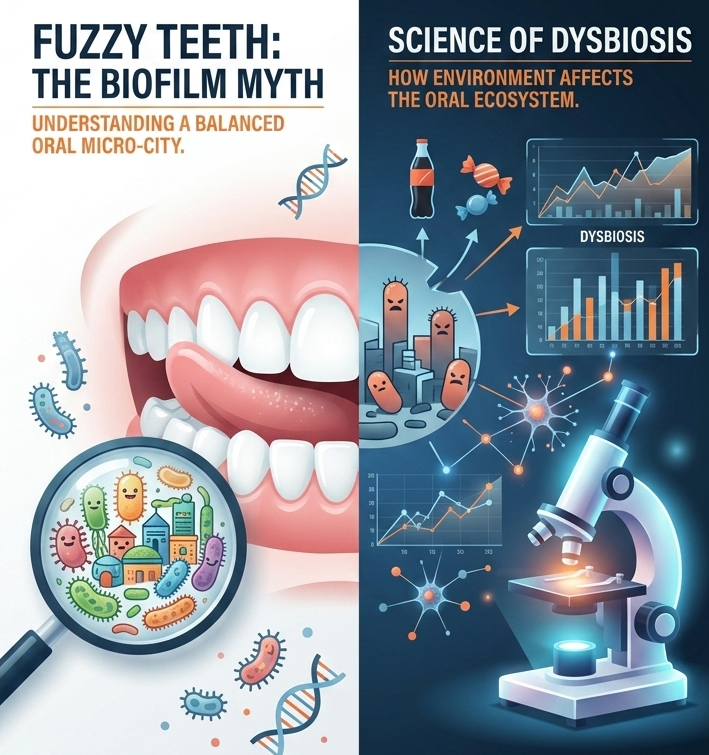
Take a moment to run your tongue across your teeth right now — especially first thing in the morning, before you’ve brushed them. That faint, fuzzy film? It’s not a sign that something has gone wrong. That’s dental plaque, and it’s present whether your mouth is perfectly healthy or starting to develop a cavity.
That surprises most people. Plaque is often portrayed as a villain—something you need to get rid of and a sign of poor dental hygiene. However, recent research on the oral microbiome presents a different perspective: plaque is a natural, living structure that forms on your teeth regardless of how well you care for them. In a healthy mouth, plaque can actually be beneficial.
Plaque Is a Biofilm, Not a Stain
The key concept that researchers continually revisit is that plaque is not merely “leftover food” or passive bacterial residue on your teeth; it is actually a biofilm. This biofilm is a structurally organized, functioning microbial community, resembling a small, self-built city rather than just a smear of grime.

That city has impressive architecture. Research on oral biofilms reveals that they form in organized layers, with different species inhabiting specific areas based on the surface, local chemistry, and available oxygen levels. Early colonizing bacteria attach first, altering the surface just enough to allow other species to settle in—much like the first settlers in a city build infrastructure before newcomers arrive. Over time, the community knits itself together through a self-produced matrix that holds everything in place and helps the community share nutrients, signals, and even genetic material.
This isn’t a fringe finding — it’s foundational to modern dental microbiology, dating back to the influential work of microbiologist Philip Marsh, who has spent decades documenting how dental plaque behaves as a structurally and functionally organised biofilm rather than a haphazard buildup.
The Part That Surprises People: It’s Supposed to Be There
Here’s a key point that challenges the common belief “plaque = bad” instinct: research consistently shows that a healthy mouth is not a plaque-free mouth. It’s a mouth where the plaque biofilm exists in a stable, balanced state.
The oral microbiota — including the bacteria that make up plaque — actively benefits its host. Studies point to several jobs this resident community does for you:
- Crowding out invaders: A well-established microbial community makes it physically and chemically harder for new, potentially harmful species to gain a foothold — a phenomenon researchers call colonization resistance.
- Keeping inflammation in check: Rather than constantly triggering your immune system, a balanced oral microbiome helps tone down unnecessary inflammatory responses.
- Supporting normal development: The resident microbiota contributes to the normal physiological development of the mouth and to training your body’s own defenses.
In other words, in health, this community is less like an intruder and more like a long-term tenant that keeps the building running — and generally, these communities live in genuine harmony with you. That relationship even has a name: symbiosis.
So Why Does Plaque Turn Into a Problem?
If plaque is normal, why do dentists still advise you to remove it? The key factor is not just the presence of plaque, but the composition of the biofilm that determines whether it is harmless.
TThis concept is central to the ecological plaque hypothesis, which is one of the most influential theories in the modern study of tooth decay. The idea is straightforward: your resident plaque bacteria are opportunists that respond to their environment. When conditions stay stable, the microscopic city stays balanced. However, if the environment changes—such as through frequent sugar intake—this can alter the local ecosystem, allowing more harmful bacteria to thrive and take over.

Here’s the mechanism in plain terms:
- You eat something sugary. Certain resident bacteria — the few “vandals” already living in the city, doing no harm in small numbers — ferment those sugars and produce acid.
- Repeated, frequent acid exposure changes the environment. It favors bacteria that tolerate and even thrive in low-pH conditions.
- These acid-loving species gradually out-compete the good neighbors, shifting the overall balance and demographics of the biofilm.
- The now acid-dominant biofilm demineralizes enamel — and that’s how a normal, healthy microscopic city becomes the cause of a cavity.
Researchers call this shift from a balanced to an unbalanced microbial community dysbiosis .Understanding this concept is important because it reframes the goal of oral care. Instead of trying to sterilize your mouth, you should aim to prevent the composition of the unavoidable biofilm from shifting toward harmful bacteria.
What This Means for How You Actually Brush
This research has a very practical payoff, and it’s a bit different from “kill all the germs”:
- Frequency of sugar exposure matters more than total amount. The frequency with which we consume sugar is more significant than the total amount consumed. Acid-tolerant bacteria benefit from repeated drops in pH, meaning that snacking on sugary foods and drinks throughout the day disrupts the balance of the biofilm more than consuming the same amount of sugar in one sitting.
- Mechanical disruption is what resets the community. Brushing and flossing don’t need to (and can’t) eliminate plaque permanently — they disrupt its structure and buy time before it re-matures into a dense, organized biofilm again, which is part of why twice-daily brushing is the standard recommendation rather than a one-time deep clean.
- Fluoride works partly as an environmental modulator. Beyond strengthening enamel directly, fluoride and similar agents help create conditions that are less favorable to acid-tolerant species, nudging the biofilm’s competitive balance back toward the harmless majority.
- A completely “plaque-free” mouth isn’t the realistic or necessary goal. Modern research treats a mature, stable, diverse biofilm as a sign of a well-functioning oral ecosystem — the target is balance, not eradication.
The Takeaway
That fuzzy feeling on your teeth in the morning isn’t evidence you’re failing at oral hygiene — it’s evidence you have a mouth, and mouths grow biofilms. The real question a healthy biofilm answers is not whether plaque is present, but “is this community still in balance?”
Understanding plaque as a living, structured, mostly friendly microbial community that can become destabilized — rather than a substance to eradicate completely — represents an important shift in perspective from oral microbiome research over the past two decades.decades.
Now that you know your mouth is a delicate microscopic city, are you accidentally carpet-bombing it with your toothpaste? Click here to read the 4 ingredients you need to check your label for.”
Next up: We head south from the mouth to the gut, where a very similar biofilm story plays out — except this time, the microscopic city might be protecting you from far more than cavities.
Leave a Reply