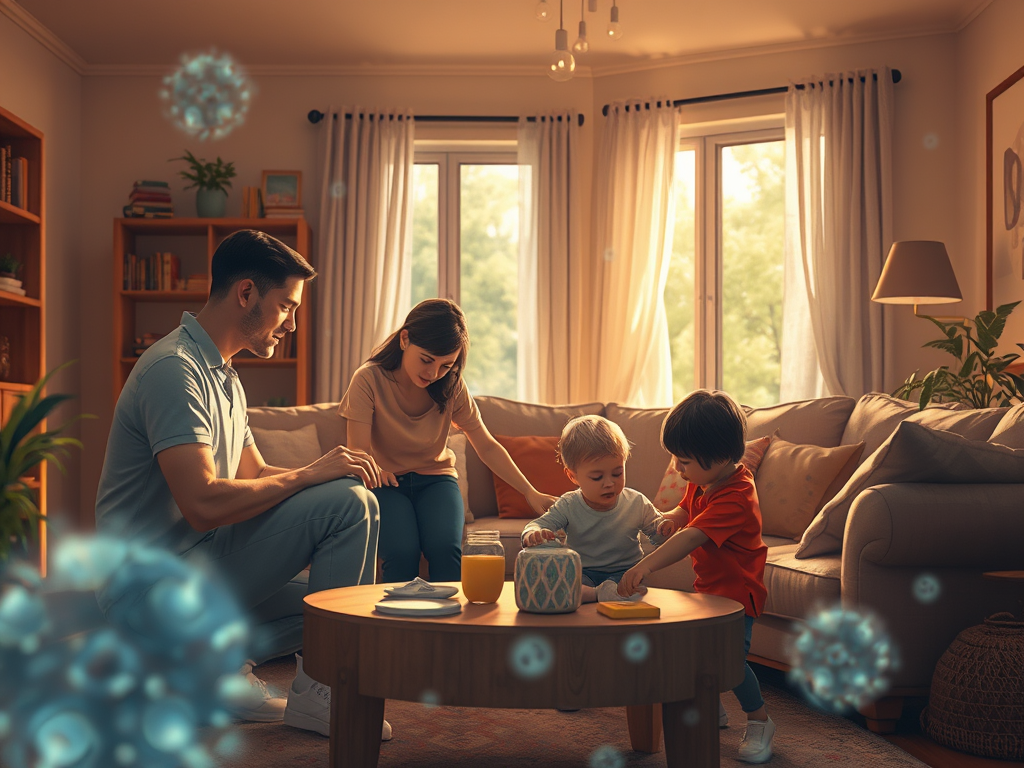
What Exactly is a “Microbial Cloud”?
Every single one of us has an invisible aura. It’s not a spiritual aura, but a biological one: a personal microbial cloud.
Research indicates that the moment you enter an empty room, you begin to alter its biological composition. Within just a few days, the environment inside a home changes to resemble the microbes of its occupants.Whether you are actively chasing a toddler through the living room or simply sitting quietly at a desk, you are constantly seeding your environment.
You are constantly seeding your environment through three primary mechanisms:
1. Direct Contact: Every time you touch a doorknob, a countertop, or a shared towel, you leave behind bacteria unique to your body.
2. The “Bioaerosol” Emission: This is where it gets fascinating. With every breath you take, and through the natural shedding of skin and hair, you release small airborne particles. A person sheds about one million (10^6) particles every hour. Many of these carry your unique bacteria directly into the air you share with your family.
3. The Dust Resuspension: As we move around—especially in busy households where multiple generations share a space—we disturb settled indoor dust. This dust is laden with previously shed skin cells and microbes, that get released back into the air.
Your home is a living, breathing reflection of the people inside it.
The Science of Sharing: How Your Family Swaps Bacteria Daily
When you live under the same roof, you share more than just space, chores, and meals—you share an entire biological ecosystem.
1. Your Hands: Research shows that our hands harbor three times more bacteria than our forearms or elbows. Because we constantly touch shared surfaces, pets, and loved ones. Genera like Firmicutes and Bacteroidetes use our hands to hitch a ride from one family member to another. While short-term environmental exposure changes your skin’s bacteria temporarily, living in a shared space long-term fundamentally alters your baseline skin microbiome to closely match your family’s.
2. The Mouth and the “Holobiont” Family: While your skin microbiome fluctuates throughout the day, your oral microbiome is highly stable and fiercely protected. Yet, it is deeply influenced by your closest relationships. Every time you kiss your partner, or test a spoonful of food to check the temperature before feeding your toddler, you are actively transmitting microbes.
This deep, generational sharing has led researchers to explore families through the lens of a “holobiont”—a fascinating concept where a couple or a family can actually be viewed as a single, combined super-organism sharing a unified microbial community.
The “Old Friends” Hypothesis: Is Sharing Healthy?
Hearing about all this bacterial swapping might make you want to grab the hand sanitizer, but don’t overdo it! This brings us to the “Old Friends” hypothesis.
While basic hygiene is essential to stop the spread of true pathogens (like foodborne or respiratory infections), over-sanitizing our homes destroys our microbial diversity. Consistent exposure to a shared family environment facilitates a healthy microbial exchange. This exposure acts like a training camp for your immune system, helping to develop immunoregulatory microbiota that can actually lower the risk of immune-mediated diseases, such as asthma and allergies.
(Bonus Fact: Do you have a dog? Studies show that dog ownership significantly increases the shared skin microbiota among cohabiting adults. You actually share more skin microbes with your own dog than you do with other people outside your home!)
Do Children and Toddlers Change the Household Microbiome?
If you have ever watched an almost four-year-old explore a house, you are witnessing a masterclass in microbiology. They touch the floor, grab a toy, hug a grandparent, and then almost immediately put their hands in their mouths. In the world of science, we call objects that transfer bacteria—like door knobs, blocks, or remote controls—fomites.

Little ones are powerful drivers of the “Family Cloud” for three reasons:
- Stirring the Air: Running and jumping violently resuspends settled dust, mixing everyone’s microbes into a unified household cloud.
- The Generational Bridge: In a shared ancestral home, a child blends the highly stable, mature microbiome of older adults (like grandparents) with their own rapidly developing ecosystem.
- Immune Training: According to the “Old Friends” hypothesis, a child’s immune system needs constant, low-level exposure to diverse household bacteria. Pulling in harmless bacteria from the family trains their body not to overreact, lowering the risk of asthma and allergies.
When your child acts as a microbial magnet, pulling in harmless bacteria from you, their grandparents, and their environment, they are actively training their immune system. So, the next time your little one is zooming around the house, leaving a trail of toys behind them, take a deep breath. They aren’t just making a mess; they are building your family’s collective immune shield.
Generational Gut Health: The Benefits of a Shared Household
Public health experts have long recognized that social isolation is harmful. Strong social relationships and living in integrated communities provide health benefits comparable to quitting smoking or maintaining a healthy weight.
Why does socializing promote physical health? As a biotech researcher, I find that our relationships nourish our microbiome. Sharing a home means engaging in a generational exchange of biology.
Massive studies show that while genetics influences some gut bacteria, shared environments determine their actual presence. Furthermore, specific bacterial strains are passed down for three to four generations. The highest transmission rates occur between mothers and daughters. By raising a daughter in a deeply connected household, you are helping her inherit your unique bacterial strains—which likely include those from your own grandmother!
A lively household doesn’t just cultivate connections; it also nurtures our health and well-being, reinforcing the importance of relationships for lasting family health.
Action Plan: 4 Ways to Cultivate a Thriving Household Microbiome
Understanding the “Family Cloud” changes how we look at our homes. The goal is no longer to live in a sterile bubble, but to cultivate a diverse, healthy indoor ecosystem. Here are four science-backed ways to enrich your shared microbial environment:
1. Share the Menu (and the Microbes): Because food dictates the gut microbiome, eating the same meals is one of the fastest ways to sync your family’s biology. Focus on shared family meals rich in diverse plant fibres (aiming for 30 different types of plants a week) to nourish your collective bacteria.
2. Clean, Do Not Sterilize: Aggressively sanitizing your entire home destroys the beneficial bacteria your immune system relies on. Stick to simple soap and water for everyday messes.
3. Ventilate Your Cloud:If your house is sealed tight with AC, you are recirculating stale bioaerosols. Open your windows for 15 to 30 minutes every morning to flush out stale air and introduce fresh, outdoor environmental microbes
4. Let the “Microbial Magnet” Do Its Job: When the little ones are crawling on the floor or playing in the dirt, they are gathering vital environmental data for the family cloud. Encourage this messy play, then just wash their hands with plain soap before dinner.

Final Thoughts: Biology is Built Together
The next time your home feels noisy, busy, or a bit chaotic, remember the invisible magic happening all around you. Our bodies were never meant to exist in isolation. By sharing a home, sharing meals, and sharing our microbes, we continuously pass down a biological legacy of resilience.
Leave a Reply