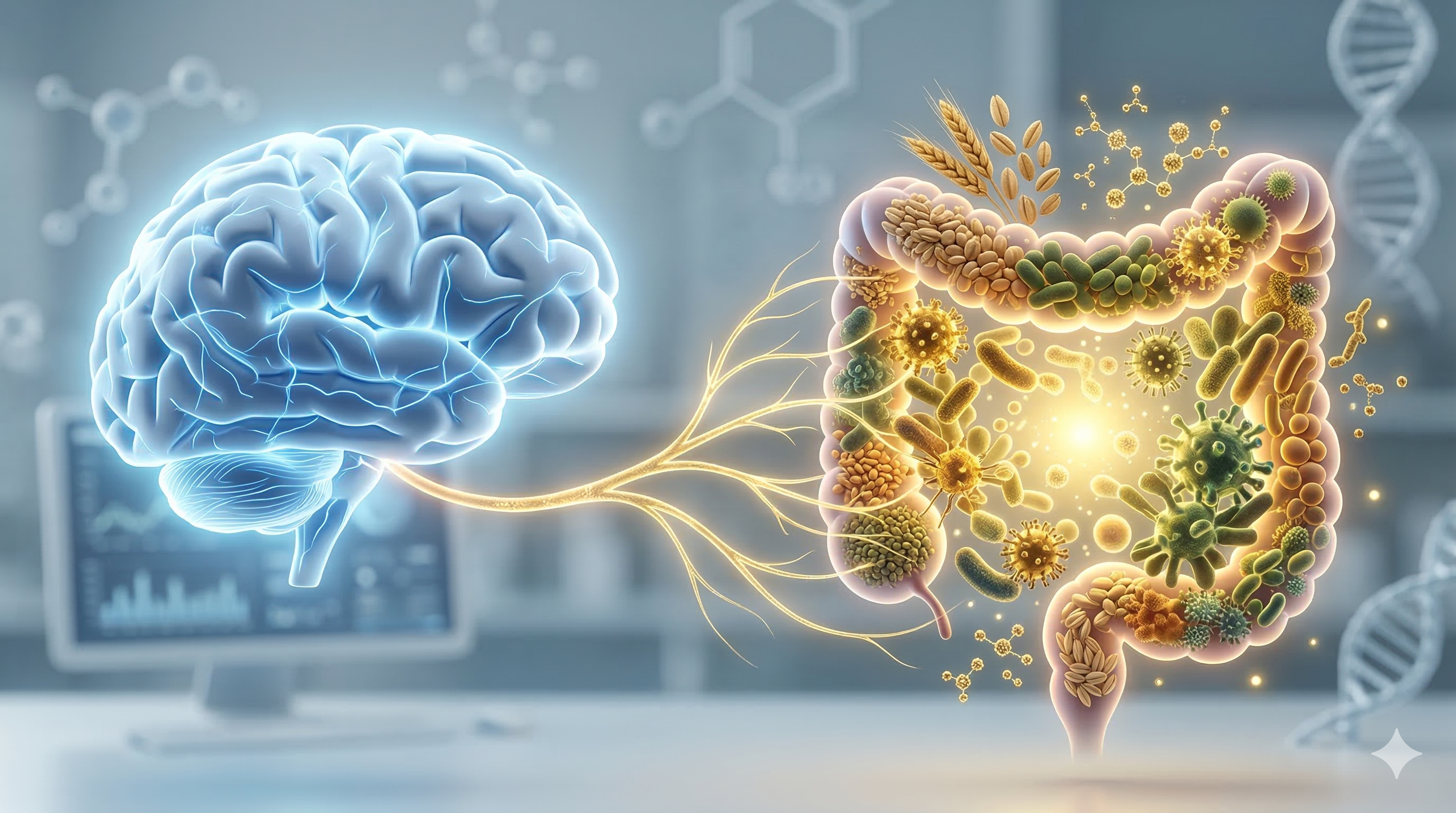
Your Gut is Your Second Brain: The Science of the Microbiota-Gut-Brain Axis
What if the most powerful antidepressant in the world isn’t a pill — it’s a bowl of yogurt?
That question would have sounded absurd a decade ago. Today, it sits at the center of one of the most exciting frontiers in modern medicine. As a Biotech researcher, I can tell you that your gut — often called your “second brain” — has a massive, underappreciated say in how you feel emotionally.
For years, the idea that gut bacteria could influence mental health was considered fringe science. By 2026, the Microbiota-Gut-Brain Axis (MGBA) had firmly transitioned from emerging hypothesis to a primary pillar of mental health research and treatment. Let’s explore how your belly’s microbes are the key to mental resilience.
This piece connects closely to my works on gut dysbiosis and fructose’s impact on the gut lining — if you haven’t read those, they provide useful grounding for what follows.
What’s Living in Your Gut? The 95% Serotonin Rule
Inside your gut lives a bustling community of trillions of microorganisms — bacteria, viruses, and fungi. These aren’t just passengers; they are a chemical factory. They help produce essential vitamins, regulate your immune system, and synthesize serotonin — the “happy chemical.”
The Fact: Roughly 95% of your body’s serotonin is produced in the gut, not the brain.
An important nuance: Gut serotonin doesn’t cross the blood-brain barrier directly. Its influence on mood is more subtle, working through the vagus nerve and other signalling pathways rather than flowing straight to the brain. This is precisely what makes the gut-brain relationship so fascinating — and so complex.
The Problem: When this delicate balance is disturbed — a condition called gut dysbiosis — it creates a neurochemical ripple effect that reaches your mind and often manifests as anxiety or “brain fog.”
The Highway Between Your Gut and Brain: The Vagus Nerve
To understand the MGBA, you need to meet its primary infrastructure: the vagus nerve.
This long, wandering nerve is the physical highway of the underground messaging network — stretching from your brainstem all the way down to your gut, passing through your heart and lungs along the way. What makes it remarkable is the direction of traffic. Roughly 80% of the signals travelling along the vagus nerve move upward — from gut to brain, not the other way around. Your gut is quite literally talking to your brain far more than your brain talks to your gut.
This is not a one-way broadcast either. The MGBA is bidirectional — stress and anxiety from the brain also travel downward, disrupting gut bacteria and worsening dysbiosis. This creates a vicious cycle that is now well-documented in clinical research: a disrupted gut worsens mental health, and worsening mental health further disrupts the gut. Breaking this cycle requires addressing both ends of the network simultaneously.
The Science: Gut Imbalance and Depression
Can bad gut health cause depression or anxiety? The latest research suggests a direct and meaningful link — though it is worth noting that in humans, much of this evidence is still correlational rather than fully causal. The direction is clear; the precise mechanisms are still being mapped.
The Amygdala Switch (2025): Research from Duke-NUS Medical School identified indoles — metabolites produced by gut bacteria — that act as direct regulators of the brain’s amygdala, the region that controls our fear and anxiety responses. When gut bacteria are depleted, indole production drops, and the amygdala loses a key calming signal.
The Mouse Study: A landmark study in Nature Communications showed that transplanting gut bacteria from “depressed” mice into healthy mice caused the healthy mice to begin displaying signs of depressive behavior. While animal studies don’t always translate directly to humans, this finding established a powerful proof of concept and opened a productive line of human research that continues today.
The eCB Connection: Scientists discovered that an unhealthy gut disrupts the body’s endocannabinoid system (eCB) — the system responsible for regulating mood and neurogenesis (the birth of new brain cells) in the hippocampus. When the messaging network goes down, this regulatory system loses its balance.
Psychobiotics: A New Signal for the Network
This research has birthed an entirely new field: Psychobiotics — specific probiotic strains used to directly support mental health by restoring signal clarity in the gut-brain network.
The Human Proof (2025 Data): A randomized trial published in Brain Sciences followed adults across New Delhi, Kolkata, and Pune. Those taking a specific psychobiotic blend of L. rhamnosus and B. longum for 12 weeks saw a 7.4% improvement in sleep efficiency and significantly lower anxiety scores compared to the placebo group.
This study deserves particular attention. Most psychobiotic research emerges from Western university settings and tests interventions on populations with very different dietary baselines. This Indian trial matters because it tests these findings on populations with distinct gut microbiome compositions — shaped by traditional South Asian diets, spice exposure, and fermented food cultures — making its results directly relevant to millions of readers who rarely see their dietary context reflected in clinical research.
To restore a healthy messaging network, research now points to three key pillars:
- Postbiotics: The beneficial byproducts produced when your bacteria digest fiber — most notably Butyrate, a short-chain fatty acid that crosses the blood-brain barrier and actively protects brain tissue.
- Prebiotics: The fuel for your beneficial bacteria — found in bananas, garlic, onions, and oats.
- Probiotics: Live beneficial bacteria themselves — found in yogurt, kimchi, and kefir.

Healing from the Inside: Your Action Plan
The good news? Your gut is remarkably flexible. You can begin shifting your microbiome meaningfully in as little as 24 hours by making these changes:
- Adopt a Mediterranean-style diet: Rich in vegetables, whole grains, legumes, and healthy fats like olive oil. This dietary pattern has the strongest evidence base for both gut and mental health.
- Diversify your fiber sources: Aim for 30 different plant foods per week to feed a wider range of beneficial bacterial strains. This doesn’t mean 30 separate meals — herbs, spices, and seeds all count.
- Embrace fermented foods daily: Yogurt, kefir, kimchi, miso, and traditional Indian fermented foods like idli and dhokla all introduce beneficial live cultures into your gut. Even a small daily serving makes a measurable difference.
- Choose mindful probiotics: For targeted mental health support, look specifically for strains like L. plantarum or B. longum, which have been clinically studied for stress and anxiety reduction.
What We Don’t Know Yet
The science is genuinely exciting — but intellectual honesty matters, especially on a topic as personal as mental health.
We do not yet have a standardized “mental health probiotic.” Individual microbiome variation is enormous, meaning the same intervention can produce meaningfully different results in different people. Most human trials in this field are still relatively short and small in scale. And while the correlation between gut dysbiosis and depression is strong and consistent, the precise causal mechanisms in humans are still being mapped.
What the research does tell us clearly is the direction — and that direction points firmly and consistently toward the gut. The network is real. The signals are real. And the tools to strengthen them are, remarkably, available in your kitchen right now.
Final Thoughts: It Starts in Your Gut
We can’t always control external stressors, but we can control the environment inside our bodies. Every meal is an opportunity to either strengthen or weaken your gut-brain messaging network. A diverse, fiber-rich, fermented-food-friendly diet doesn’t just feed your microbiome — it restores signal clarity, supports your amygdala, and builds the kind of mental resilience that no external circumstance can easily take away.
If you read blogs about how fructose affects your liver, gut health, and brain signals, you will see that these topics are connected. They tell one story. The decisions you make while eating influence everything, from your gut to your mind, in ways that science is just starting to understand.
Your mental resilience doesn’t start in your mind. It starts in your gut — and it starts at your next meal.
“A happy gut, a happy me.”
Leave a Reply